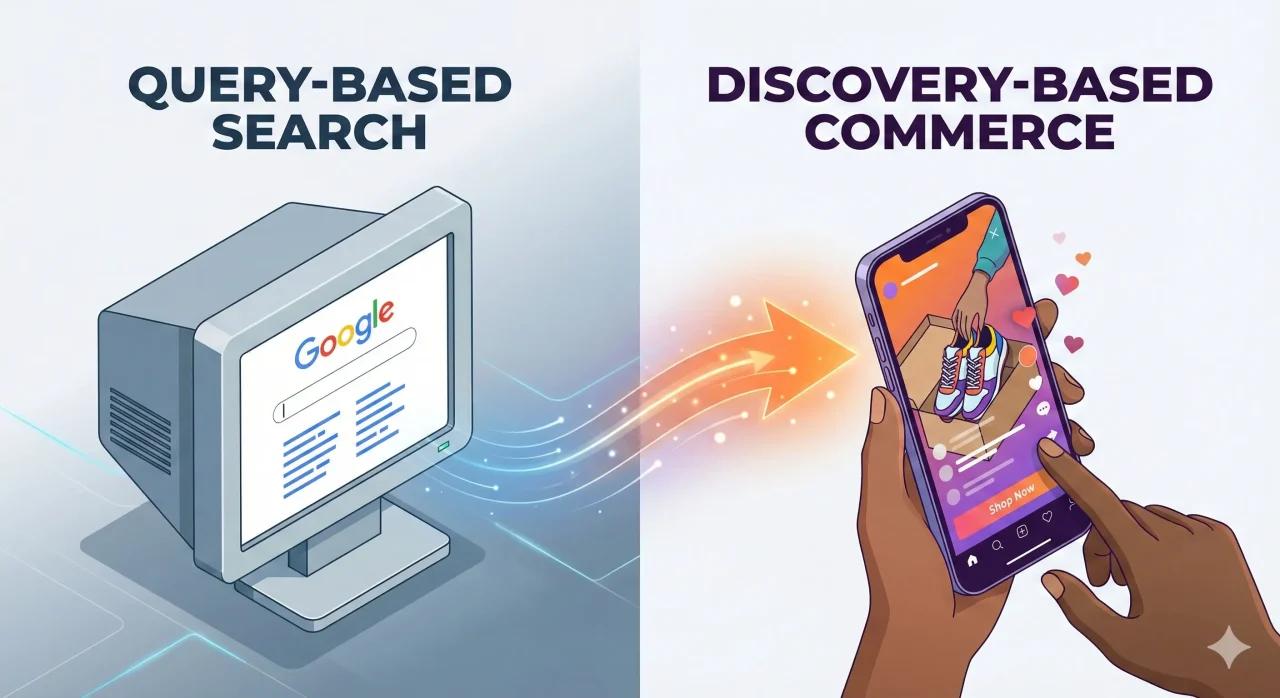
For e-commerce professionals, the classic sales funnel was predictable: a user realizes a need, searches for a solution on Google, compares options, and buys. That linear path is breaking down. We are entering the era of “Discovery-Based Commerce,” where the customer doesn’t even know they want your product until the algorithm shows it to them.
Recent data paints a startling picture for online retail. The “search bar” is being replaced by the “For You” feed, fundamentally changing how products are found and bought.
The New Digital Shelf: Discovery vs. Intent
The shift is from reactive to proactive. Traditional search engines wait for a user to ask a question. Social platforms answer questions users haven’t asked yet.
This isn’t just a theory; the market numbers confirm the takeover.
- The Market Shift: TikTok Shop alone is projected to make up nearly 20% of all social commerce in 2025. This signals that social apps are no longer just for “awareness”—they are becoming the transaction engine itself.
- The Implication: If your product isn’t discoverable via video content and social algorithms, you are missing out on a massive chunk of the market that no longer bothers to leave the app to buy.
Why Google is Losing the “Local War”
To understand why this migration to social is happening, we must look at how younger generations navigate the real world. They aren’t looking for blue links; they are looking for visual proof.
According to recent benchmarks for 2025/2026, the behavior for local discovery has flipped:
- Instagram First: A staggering 67% of young users now turn to Instagram to search for local businesses and explore new places.
- TikTok Second: Similarly, 62% use TikTok for the same purpose.
- The “Vibe Check”: Why the switch? A Google Maps listing gives you an address. A TikTok video gives you the “vibe”—the atmosphere, the crowd, and the unedited reality of the product or service.
The Rise of “Content-Driven Commerce”
The research highlights a critical “Trust Paradox.” Users prefer the format of social media (short, human, visual), even when it disrupts traditional shopping habits.
- Influencer Impact: The social commerce market is being primarily driven by influencer marketing. Consumers are looking for “people,” not “brands,” to guide their purchasing decisions.
- The Echo Chamber Risk: However, this shift comes with risks. Unlike search engines that rank by authority, social algorithms rank by engagement. This creates a landscape where “viral” often beats “factual,” a challenge brands must navigate carefully.

What’s Next?
The transition from “Query-Based Search” to “Discovery-Based Search” is just the beginning of a larger transformation in how we interact with the internet.
This is the first article in a 3-part series exploring the cognitive metamorphosis of digital search. In the next article, we will dive deeper into how specific industries—from Travel to Finance—are being disrupted by this shift.
Leave a Reply